
Home » Posts tagged 'US' (Page 3)
Tag Archives: US

Senate Foreign Relations Committee Hearing: Need for Stronger US Leadership on Food Security in a Time of Climate Crisis
By Ethan Wong and Siena Cicarelli
On March 6, the US Senate Foreign Relations Committee (SFRC) held a hearing on global food security featuring testimony from Dina Esposito, Assistant to the Administrator, Bureau for Resilience, Environment, and Food Security at the US Agency for International Development (USAID) and Dr. Cary Fowler, Special Envoy for Global Food Security at the US Department of State.
This hearing came at a critical time for development, diplomatic and food security leaders alike. In her testimony, Ms. Esposito noted that over 735 million people are chronically hungry and the state of global food security is only worsening. Ongoing and emerging conflicts continue to drive food insecurity, particularly through the weaponization of food, as seen in Gaza and Ukraine. At the same time, shifting weather patterns and increasing climate extremes have threatened global supply chains and future food production. These recent shocks highlight the urgent nexus between hunger, climate, and conflict – and the need for greater US leadership in building resilient and future-fit food systems.
(more…)
Event Summary: Climate Geopolitics and The U.S. Military at COP28
By Elsa Barron
On the first Monday of COP28 in Dubai, the Center for Climate and Security (CCS) and the University of Pennsylvania hosted U.S. Assistant Secretary of the Army Rachel Jacobson and U.S. Deputy Assistant Secretary of Defense (DASD) for Arctic and Global Resilience Iris Ferguson for a fireside chat with Dr. Scott Moore on “Climate Geopolitics and The U.S. Military: Risks and Opportunities.” In response to shifting global dynamics and intensifying risks to human well-being around the world as a result of climate change, the panel addressed how governments must adapt their institutions to meet unprecedented challenges—with specific attention to climate change-related geopolitical dynamics and how they shape U.S. partnerships, risks, and opportunities abroad.
DASD Ferguson began by sharing that their delegation has received questions about why the U.S. Department of Defense (DoD) has been present at COP over the past two years, given that they are a non-traditional player in the climate space. In response, she noted that DoD has been working at the intersection between climate change and security for decades and the latest National Defense Strategy set a strong demand signal that climate change is a national security priority. The partnerships made at COP—with diplomats, policymakers, and industry representatives—are crucial to building the Department’s capacity to mitigate and adapt to climate challenges. Both speakers emphasized that the military has a lot to learn in an environment like COP28. While Jacobson said that they may not be known as “tree-huggers” Ferguson emphasized “if you’re not here, you’re not relevant” and both representatives indicated that they want to show up as relevant and useful partners to face climate challenges.
As an example of ongoing partnerships, Assistant Secretary Jacobson shared that the Army Corps of Engineers is engaged in climate adaptation around the world, especially related to water management. In Paraguay, they have a five-year partnership on river management, in Mozambique, they are collaborating on watersheds, and in Ecuador, they are helping repair environmental degradation from dam infrastructure. The Army Corps was also central in responding to the flooding in Pakistan last year, which CCS has previously highlighted as an example of climate security risk.
Ferguson added that the US military’s regional combatant commands are working globally to respond to climate change, which is often defined by local partners and allies as the number one security risk. She applauded the development of the CCS’s Military Responses to Climate Hazards (MiRCH) Tracker, which illustrates the significance of militaries as some of the first responders to climate disasters, not only in the United States but around the world. On this point, Jacobson added that the Army’s strength in logistics is what sets it apart as first responders to climate disasters. Increasingly, troops are training to respond to climate-related hazards because that is what they are being called up to do. In light of this growing need across countries and communities, DoD is thinking about ways to build the capacity of partner militaries, particularly through the Department’s Defense Operational Resilience International Cooperation (DORIC) pilot project.
It is not only climate adaptation but also the transition to renewable energy that comes with risks and opportunities for the US military. Ferguson stated that the war in Ukraine provided a wake-up call for the need to ensure sufficient energy resources from a dependable source. Domestically, she noted this can be accomplished through distributed generation on military bases. Considerations relating to supply chain reliability and interoperability must be made, but both speakers emphasized the importance of decarbonization to reduce the emissions footprint of the military. Returning to base infrastructure, Jacobson noted that installing microgrids is essential for both energy security and sustainability. Even on the operational side, it makes sense to switch to renewable energy sources. She shared that in Iraq and Afghanistan, some of the most vulnerable soldiers were those transporting fuel. Those vulnerabilities can be avoided with sustainable technologies that minimize the need for oil.
In response to the conversation on stage, the audience inquired about military emissions reporting, noting the gap in UN Framework Convention on Climate Change (UNFCCC) emissions reporting requirements for militaries, and the importance of transparency and accountability for reducing emissions from all global contributors. Another audience member wondered whether DoD might consider U.S. investments into the Loss and Damage fund as an opportunity to support communities facing the harshest climate change impacts, resulting in positive security dividends. Both of these questions present opportunities for further thinking in the wake of COP28, especially if DoD plans to continue its attendance at the global climate conference in years to come.
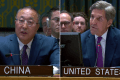
The Geopolitics of Climate Change: China and the United States at the UN Security Council
On 13 June, the United Nations Security Council (UNSC) held a ministerial-level open debate on climate change, peace and security—the latest in a series of UNSC meetings on the topic. While many ministerial statements focused on the nexus of climate change, instability, and conflict, the conversation underscored how today’s competitive geopolitical dynamics are complicating good-faith efforts to address climate security in such multilateral fora. Statements from China, in particular, suggest it sees a geopolitical opportunity in such discussions. Namely, due to the United States and other countries in the Global North failing to live up to their commitments to provide climate finance, especially adaptation funds, to the Global South.
In last week’s meeting, China used its time at the microphone to level a series of pointed comments aimed implicitly at the United States and the European Union (EU). Beijing’s Permanent Representative to the UN, Zhang Jun, argued there were three areas in which the UNSC should focus its attention.
(more…)BRIEFER: Deepening U.S. Climate Security Ambition: A Road Map for 2023
By Brigitte Hugh and Erin Sikorsky

In 2022, the world faced the challenging reality of the nexus of climate change and security on a daily basis. From deadly floods, heatwaves, and droughts across nearly every continent, to an energy and food security crisis sparked by the Russian invasion of Ukraine, the impact of climate change and continued use of fossil fuels has increased instability and insecurity for communities around the globe.
At the same time, U.S. policymakers and practitioners took unprecedented actions to address these intersecting security challenges. Many of these actions reflected recommendations the Center for Climate and Security (CCS) had made in the past – both in a short report, Taking Stock: Integrating Climate Change into U.S. National Security Practices in 2022 and the more in-depth Challenge Accepted: A Progress Report on the Climate Security Plan for America and Recommendations for the Way Ahead, endorsed by nearly 80 senior national security leaders.
While we applaud and detail this progress in this briefer, we also recognize that it is far from enough. In particular, global investments in adaptation and resilience measures are woefully inadequate. The failure of the United States to increase climate finance funding last year – falling well short of its international pledges – was a missed opportunity to invest in U.S. national security. Helping the most climate-vulnerable countries address climate hazards can prevent instability and conflict that threatens U.S. interests, and strengthens U.S. credibility and leadership on the global stage.
In 2023, U.S. policymakers and practitioners will have many opportunities to solidify and institutionalize progress on climate security. Overall, the key themes for 2023 should be: execution, integration, and sustainability. Strategies and roadmaps have been created – now it is time for implementation.