
Home » Posts tagged 'climate change and security' (Page 5)
Tag Archives: climate change and security

July 2023 Update: Military Responses to Climate Hazards (MiRCH) Tracker
By Tom Ellison and Erin Sikorsky
In July 2023, the Military Responses to Climate Hazards (MiRCH) tracker identified 16 countries in which militaries were deployed in response to climate hazards, often multiple times to different regions and types of hazard. The tracker identified 31 deployments total. Additionally, extreme weather events interrupted military activities and destroyed military infrastructure this month, underscoring the multiple ways in which these hazards strain defense and security capabilities.
(more…)
June 2023 Update: Military Responses to Climate Hazards (MiRCH) Tracker
By Tom Ellison and Erin Sikorsky
In June, the Military Responses to Climate Hazards (MiRCH) tracker identified 15 instances of military responses to climate change-related hazards across the globe. For much of the month, hundreds of wildfires burned across Canada, leading to the deployment of around 550 troops and associated aircraft equipment to assist in firefighting. The Canadian Chief of the Defense Staff Wayne Eyre warned that disaster response is straining the military’s ability to fulfill its core duties, and Ottawa is considering creating a national disaster response agency, akin to FEMA, for the first time.
In the United States in late June, a large swath of the country was experiencing dangerous levels of heat, which the National Weather Service defines as 103° to 125°F. At these temperatures, heat cramps or heat exhaustion are likely, and heat stroke is possible with prolonged exposure or physical activity. The affected region includes multiple military bases such as Camp Shelby Joint Forces Training Center in Mississippi and Fort Huachuca in Arizona. The latter experienced a wildfire in late June that affected its power supply.
In South Asia, Cyclone Biparjoy prompted the evacuation of 173,000 people in Pakistan and India in June, highlighting challenging dynamics around military deployments to climate hazards. Rivals India and Pakistan deployed military forces to Gujarat and Sindh Provinces, respectively, to deal with Biparjoy’s landfall, almost certainly saving lives. The rival governments’ real-time coordination of relief was reportedly minimal, however, consistent with past disasters, highlighting the obstacles security tensions pose to collaborative responses to transboundary climate hazards. Additionally, in Pakistan, the military conducted short-notice evacuations of 60,000 people to nearby relief camps, highlighting their ability to mobilize quickly, but also spurring complaints from some residents over mandatory relocations and inadequately equipped camps.
Finally, Biparjoy illustrated the compounding strain of back-to-back climate hazards on militaries and communities. In Pakistan, the cyclone hit the same areas that suffered devastating floods last year, while the Indian military the same week had to rescue 2,000 tourists trapped by extreme precipitation and flooding, 1500 miles away in North Sikkim Province.
Meanwhile, events in Myanmar show how repressive militaries can weaponize climate relief. There, Cyclone Mocha’s landfall in mid-May devastated the largely minority Muslim Rakhine state. In recent weeks, the ethnic insurgent group the Arakan Army has provided humanitarian relief and the ruling military junta blocked international aid from reaching needy communities, putting thousands of lives at risk.
To see the full MiRCH tracker with new updates for June, click here.

Leadership in the Polycrisis: How UK Defense Training Can Help Us Navigate a Future of Unprecedented Environmental Disruption
By Laurie Laybourn and Matt Ince
Edited by Erin Sikorsky and Francesco Femia
Introduction

The global scale, systemic interconnection, and severity of today’s climate and ecological crises has led researchers to conclude that the world has entered a new era—or overall state—of complex, cascading, and compounding risk.1 Some have labelled this the ‘polycrisis.’2 Approaches to leadership development in a defense context—which commonly focus on the ability to operate effectively under intense conditions—might have increasing relevance for civilian leaders wanting to enhance their capacity to respond to this emergent polycrisis era. We undertook research exploring these approaches, utilizing structured workshops and interviews with around thirty senior officers and personnel across the United Kingdom (UK) Defense enterprise. We found that the strong emphasis placed on physical and mental resilience, situational rehearsal, and an initiative mindset grounded in organizational structure and team ethos will increasingly have a broader leadership applicability as the destabilizing consequences of the climate and ecological crisis grow. This briefer explores our findings.
(more…)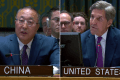
The Geopolitics of Climate Change: China and the United States at the UN Security Council
On 13 June, the United Nations Security Council (UNSC) held a ministerial-level open debate on climate change, peace and security—the latest in a series of UNSC meetings on the topic. While many ministerial statements focused on the nexus of climate change, instability, and conflict, the conversation underscored how today’s competitive geopolitical dynamics are complicating good-faith efforts to address climate security in such multilateral fora. Statements from China, in particular, suggest it sees a geopolitical opportunity in such discussions. Namely, due to the United States and other countries in the Global North failing to live up to their commitments to provide climate finance, especially adaptation funds, to the Global South.
In last week’s meeting, China used its time at the microphone to level a series of pointed comments aimed implicitly at the United States and the European Union (EU). Beijing’s Permanent Representative to the UN, Zhang Jun, argued there were three areas in which the UNSC should focus its attention.
(more…)