
Home » Posts tagged 'United Nations'
Tag Archives: United Nations

Climate Security at the 79th UN General Assembly and Climate Week: What to Watch
By Noah Fritzhand and Siena Cicarelli
As hundreds of world leaders, policymakers, advocates, and experts make their way to New York for the 79th United Nations General Assembly (UNGA) and Climate Week, the stage will once again be set for discussions on some of the most pressing international issues, including climate security.
As 2024’s record-breaking heat, “extraordinary” hurricane season, and growing food security risks demonstrate, climate change is already impacting global livelihoods and security in profound ways. At the end of August, UN Secretary-General António Guterres released a study on the impacts of climate-change-induced loss and damage on global human rights, identifying the nexus between climate change, conflict, hunger, and mobility as a key threat to human rights and security. Critically, the report highlights the need for direct funding for disproportionately affected communities including in conflict and fragile settings – a challenging task for today’s development leaders and international financial institutions.
(more…)
Climate Finance, Food Security, and Cracks in the Transatlantic Alliance at COP28: Recommendations for the Global Stocktake
This blog post is part of the Nexus25 project, a joint initiative of the Istituto Affari Internazionali and the Center for Climate and Security, focused on sustainable multilateralism, and supported by Stiftung Mercator.
In the runup to the 28th Conference of the Parties (COP28) to the UN Framework Convention on Climate Change (UNFCCC), climate change’s role in complex security and humanitarian crises is continuing to challenge the capacity and ambition of the international community. As perhaps the most contentious issue in global climate action, climate finance is rightly a top priority for advocates and world leaders in Dubai.
While most member states recognize that climate change is driving, and will continue to drive, migration and food insecurity, and is disproportionately impacting marginalized populations, climate finance is a glaring gap in their policies and plans to respond to the resulting threats. The massive injection of funding required and the domestic politics that continue to stymie investment from world leaders is a critical barrier to meeting countries’ emissions and resilience goals, or Nationally Determined Contributions (NDCs). In this context, we recommend three key priorities in the leadup to COP28: finding new approaches to climate finance; improving messaging on the urgency of the climate threat; and repairing transatlantic relations to show leadership.
(more…)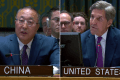
The Geopolitics of Climate Change: China and the United States at the UN Security Council
On 13 June, the United Nations Security Council (UNSC) held a ministerial-level open debate on climate change, peace and security—the latest in a series of UNSC meetings on the topic. While many ministerial statements focused on the nexus of climate change, instability, and conflict, the conversation underscored how today’s competitive geopolitical dynamics are complicating good-faith efforts to address climate security in such multilateral fora. Statements from China, in particular, suggest it sees a geopolitical opportunity in such discussions. Namely, due to the United States and other countries in the Global North failing to live up to their commitments to provide climate finance, especially adaptation funds, to the Global South.
In last week’s meeting, China used its time at the microphone to level a series of pointed comments aimed implicitly at the United States and the European Union (EU). Beijing’s Permanent Representative to the UN, Zhang Jun, argued there were three areas in which the UNSC should focus its attention.
(more…)Do We Need a New Climate Risk Regime?
 By Neil Bhatiya, Climate and Diplomacy Fellow
With the completion of the Paris Agreement in December of last year, the international community fashioned a universal accord on climate change. As a new E3G Report, United We Stand: Reforming the United Nations to Reduce Climate Risk, makes clear, however, Paris is only one part of the equation. The problem, which this report tries to address, is that the international system’s ability to deal with climate risk – the impacts from climate change that are already occurring – is fragmentary and ad hoc. (more…)